
Choosing between a KBK light crane system and a jib crane is one of the first layout decisions in a workstation lifting project, and it is usually made too late — after the building is fixed and the slab is poured. Both systems solve the same problem from opposite directions. A KBK system spreads tracks across an area and lets the hook travel in two axes; a jib crane concentrates the entire load path on a single column and lets the arm rotate. Choose wrong and you either buy an area system for one workstation, or you pour a foundation you cannot move when the line changes.
This guide compares the two on the criteria that actually decide commercial projects: coverage geometry, capacity ceiling, structural support, headroom, expansion, and where the money goes. Every specification quoted below is from the KRC range — the KBK light crane system and the jib crane series — and the worked examples are layout studies, not product specifications.
What a KBK Light Crane System Actually Is
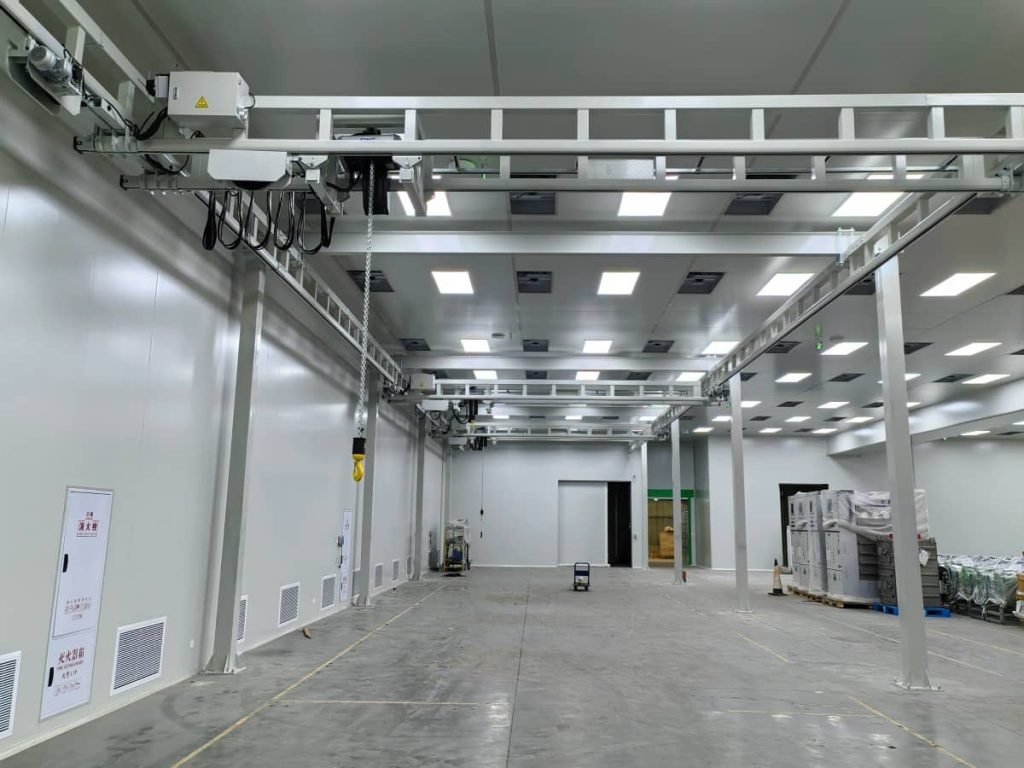
A KBK light crane system is a modular overhead handling system built from tracks, suspension units, trolleys, bridges, hoists, end stops, power supply components, and safety devices. The hook does not swing around a pivot; a bridge carries it across the width of a bay while the bridge itself runs along the track, so the hook reaches any point inside the rectangle the tracks define. Compared with a conventional overhead travelling crane, the tracks are lighter, the suspension loads are smaller, installation is faster, and the layout can be reworked when the production line moves.
KRC builds three rail families under this system, and they are not interchangeable — each one answers a different constraint.
| Rail family | Max. lifting capacity | Max. span | What it is for |
|---|---|---|---|
| Aluminium alloy rail | Up to 2,000 kg | Up to 10 m | Light to medium-duty workstation handling; enclosed aluminium profile with low rolling resistance, quiet movement and good corrosion resistance |
| Rigid steel track | 2,000 kg single girder / 3,000 kg double girder | Main beam up to 12 m | Larger spans and higher capacity where structural stability matters; can be arranged as a free-standing workstation crane where roof suspension is limited |
| Flexible steel KBK track | Up to 2,000 kg | Up to 10 m | Frequent industrial handling and modular workstation layouts that will be rearranged; Q355B rail with Q355D available, roll-formed joint, reinforced trolley and secondary safety protection |
Where KBK stops
Two limits matter commercially. First, capacity: outside the rigid double-girder configuration, the track families top out at 2,000 kg, and the rigid double-girder arrangement reaches 3,000 kg. Second, suspension: the system has to hang from something. Where the roof structure cannot take the suspension loads and a free-standing arrangement is not practical, a KBK system stops being the cheap option.
What a Jib Crane Actually Is
A jib crane is a crane with a horizontal arm, or jib, that slews about a vertical axis and carries a hoist trolley along its length. This is not a detail of naming — ISO 4306-1:2026, Cranes — Vocabulary classifies cranes separately by construction, mode of movement, slewing capability and mode of installation, which is why a jib crane and an overhead travelling crane sit in different categories rather than being two shapes of the same machine. A jib crane covers a disc. Whatever else it does, that single fact drives the layout.
Pillar, wall-mounted and articulated: three different machines
The KRC range covers four families, and the right one depends on where you can put the support and what the arm has to reach around.
| Family | Series | Capacity | Outreach | Mounting |
|---|---|---|---|---|
| Aluminium rail slewing jib | LS | 125–2,000 kg | Up to 10 m | Pillar mounted |
| C-rail low headroom / slewing jib | LSX-H, LSX-C | Up to 1,000 kg | Up to 10 m | Pillar or suspension |
| Heavy-duty I-beam jib | VS, VS-M, VS-E | Up to 5,000 kg (VS / VS-E); 3,000 kg (VS-M) | Up to 10 m (8 m for VS-M) | Pillar mounted, manual or electric slewing |
| Wall / column mounted jib | VW | Up to 3,000 kg | Up to 10 m | Building column or reinforced wall — no floor column |
| Mobile pillar jib | LS-M | Up to 1,000 kg | Up to 4 m | Mobile base, relocatable |
| Articulated knuckle jib | LS-K, LS-KI | Up to 1,000 kg (LS-K); up to 500 kg (LS-KI) | Up to 6 m | Pillar mounted; knuckle arm reaches around machines |
| Micro jib / pneumatic balancer | WD, WD-D, XB9000 | 100–200 kg | 550–1,300 mm | Bench, pillar or mobile base |
Wall and column mounting is the option most often overlooked. The VW series mounts directly on a building column or reinforced wall and eliminates the floor-mounted support column entirely, which is worth a serious look when floor space at the workstation is the binding constraint.
Where a jib crane stops
A jib crane cannot cover a long line of stations without a supporting column at each one, and beyond the outreach limit the hook simply does not reach. Those two limits — one pivot, one radius — are what the next section quantifies.
The Difference That Decides Most Projects: Coverage Geometry
The hook of a jib crane can reach any point within a radius equal to its outreach, measured from the pivot. The hook of a KBK system can reach any point inside the rectangle the tracks and bridge describe. A circle and a rectangle are different shapes, and most production areas are rectangles.
That single mismatch produces three predictable consequences:
- Long, narrow areas waste jib coverage. A conveyor line, a racking aisle or an assembly line 20 m long and 6 m wide suits a track system. Covered with jibs it needs several pivots, and each circle is far wider than the space it serves.
- Corners are the expensive part of a jib layout. To reach the far corner of a rectangular station, the outreach must equal the diagonal distance from the pivot to that corner — not the half-width.
- Everything outside the work area still gets swept. A jib rotates through a full circle. If the station is narrower than the sweep diameter, the arm passes over the aisle, the walkway, or the neighbouring machine on every cycle.
There is a boundary beyond both systems as well. When the area is large enough that neither a light track system nor a jib covers it economically, the comparison moves up a class to a conventional overhead travelling crane — the European single girder hoist crane is normally the first step, and the span, capacity and duty class are then set by the building rather than by the workstation.
Working out whether a jib can reach
Place the pivot at the centre of one edge of the workstation. If the workstation is L long and W deep, the required outreach R is:
R ≥ √( (L ÷ 2)² + W² )
For a 6 m × 4 m workstation, that gives R ≥ √(3² + 4²) = 5 m. So the smallest jib that reaches every corner of that station has a 5 m outreach — not 2 m, and not 3 m. Working from the half-width instead of the diagonal is the most common sizing error in jib crane selection, and it shows up later as a corner the operator cannot serve.
Side-by-Side Comparison
| KBK light crane system | Jib crane | |
|---|---|---|
| Coverage shape | Rectangle, defined by the rail layout | Circle, centred on the pivot |
| How the hook moves | Two axes: along the track and across the bridge | Slews around the pivot; trolley travels along the arm |
| Capacity ceiling (KRC range) | 2,000 kg on aluminium and flexible steel rail; 3,000 kg on rigid double girder | Up to 5,000 kg on VS / VS-E; range starts at 100 kg on the WD micro jibs |
| Maximum reach | Span up to 10 m; rigid main beam up to 12 m | Outreach up to 10 m |
| Support | Suspended from the roof structure, or free-standing frame | Pillar on a floor foundation, or mounted on a building column / wall (VW) |
| Load path | Distributed across several suspension points | Concentrated as an overturning moment at the base |
| Multiple stations | One system can serve several stations; add bridges to the same rails | One pivot per station |
| Expansion | Modular — extend tracks, add bridges, add hoists | Add another column and jib |
| Headroom | Track depth plus trolley plus hoist consumes hook height | C-rail low-headroom series (LSX-H) for restricted buildings |
| Typical best fit | Production lines, cells, larger rectangular coverage, loads within the 2–3 t band | One concentrated workstation, heavier loads, standalone or wall-mounted installations |
| Typical binding constraint | The roof or frame has to carry it | Foundation, floor area, and clearance for the sweep |
Capacity Comes Before Layout
Run the capacity check first, because it can end the comparison before geometry matters. Take the heaviest load, add the hoist and trolley, add any below-the-hook device such as a spreader beam, magnet or vacuum lifter, and compare that total with the ceiling of each option.
If the working load exceeds 2,000 kg, the aluminium and flexible steel KBK rails are out. The rigid double-girder configuration reaches 3,000 kg. Above that, the heavy-duty jib series takes over — VS and VS-E are rated up to 5,000 kg, with VS-M at 3,000 kg for manual slewing duty. In that band the decision is made on capacity, not on coverage.
Where the load is heavy and the process also calls for automated positioning, storage or casting duty, the KRC smart crane systems sit above both options in this comparison and are specified as a separate class of project.
Capacity alone is not the specification, though. Two systems with the same nominal rating are different machines if one is classified for occasional handling and the other for continuous production. ISO 4301-1:2016, Cranes — Classification is the standard that separates them: it classifies a crane and its mechanisms from the total number of working cycles over the design life, the load spectrum factor, and the average displacement per cycle. State your cycles per hour, hours per shift and shifts per day, and the duty class follows — and with it, the mechanism specification.
Where the Load Goes: Foundation or Roof
The two systems put their loads into completely different parts of the building, and this is where projects are lost. The question to answer early is simple: can the structure you intend to use actually take the load you intend to hang on it?
What a pillar jib puts into the floor
A pillar jib converts the load into an overturning moment at the base plate. That moment is the product of the load and the outreach — and it grows fast. A 3,000 kg load at 6 m outreach produces a load moment of about 18,000 kg·m, roughly 176 kN·m, before the jib’s own weight and any dynamic effects are added. For comparison, that is the kind of moment a small building column is designed to resist, applied to a single pad.
This is why a jib crane project is not finished when the crane is selected. The load cases and load combinations for the structure come from ISO 8686-1:2012, Cranes — Design principles for loads and load combinations, and the proof of competence for the steel structure follows ISO 20332:2016, Cranes — Proof of competence of steel structures. The foundation itself has to be designed by a structural engineer against your actual slab and soil conditions. Treating the foundation as an afterthought is the single most expensive mistake on this page.
What a KBK system puts into the roof
A KBK system spreads its load across several suspension points instead of concentrating it at one base. Nothing is poured and nothing is anchored into the floor — which is exactly why the system is attractive in leased buildings and in plants that reorganise production. But “distributed” is not the same as “small”. The suspension points still transfer the full weight plus dynamic effects into the roof or frame, and a roof that was never assessed for hanging loads is a real problem. Where the building cannot take it, the rigid and flexible steel track systems can be arranged free-standing, so the load goes into frame legs and pads instead.
Worked Example: A 20 m × 8 m Assembly Bay
Take an assembly bay 20 m long and 8 m wide, 160 m² of working area, with a 1,500 kg load and a track height that allows a 10 m outreach jib. Both options fit the capacity. The layout is what separates them. The dimensions below are an illustrative study, not a delivered project.

Option 1 — two jib cranes
Place two VS-E jib cranes on the long centreline, pivots at 5 m and 15 m, each with 10 m outreach and electric slewing. Each unit sweeps a circle of π × 10² ≈ 314 m², so the pair sweeps about 628 m² of circle to serve a 160 m² bay — roughly a quarter of the swept area is inside the working area. Each circle is 20 m across while the bay is 8 m deep, so 6 m of sweep crosses into the aisle on either side of the centreline. The layout needs two foundations, and each station is independently served, which is a genuine advantage if two operators work the bay at once.
Option 2 — one KBK system
Run two parallel rails 20 m long at 8 m centres and a bridge spanning the 8 m between them. Coverage is exactly 20 × 8 = 160 m², with no overshoot and no overlap. An 8 m span sits comfortably inside the 10 m span limit, and the rigid double-girder configuration covers up to 3,000 kg if a heavier part appears later. No foundations, one structure, and if a second lifting point is needed, a second bridge goes onto the same rails rather than a second column going into the floor.
What the numbers say
On this bay the track system covers the working area with about 160 m² of system coverage, while the jib option sweeps roughly 628 m² to do the same job. That ratio — around 4:1 — is the coverage-geometry penalty in one number, and it is the reason long rectangular areas almost always end up on tracks.
Three things can overturn that conclusion, and all three are common:
- Capacity. At 3,500 kg the KBK option fails on capacity and the jib wins before geometry is discussed.
- Structure. If the roof cannot take suspension loads, the KBK system needs a free-standing frame, and the cost comparison changes.
- Clearance. If the aisles beside the bay are working aisles, a jib arm sweeping across them on every cycle is a safety and logistics problem regardless of the coverage maths.
Projects like this one are where the layout and the equipment specification have to be solved together. KRC’s delivery on comparable rigid-rail and heavy-duty installations is documented in the project case library.
Selection Checklist: Eight Questions That Settle It
Answer these in order. The first two can decide the project on their own.
| # | Question | If yes | If no |
|---|---|---|---|
| 1 | Does the total load — part, hoist, trolley and any below-the-hook device — exceed 2,000 kg? | Jib crane (KBK standard rail is out; rigid double girder reaches 3,000 kg) | Both remain open |
| 2 | Can the roof or an existing frame safely take additional suspension loads? | KBK is the cheaper route | KBK needs a free-standing frame, or use a jib with a foundation |
| 3 | Is there more than one workstation to serve? | KBK — one system, several bridges | A single jib may be enough |
| 4 | Is the working area roughly rectangular and longer than it is wide? | KBK — rectangle to rectangle | A jib’s circle fits better |
| 5 | Is the load concentrated at one machine or cell within a few metres? | A jib crane is usually the efficient answer | Consider a track system |
| 6 | Is the workstation within reach of a building column or reinforced wall? | Consider the wall-mounted VW jib — no floor column | Plan for a pillar foundation |
| 7 | Will the layout change within three to five years? | KBK — modular and relocatable | A fixed jib becomes viable |
| 8 | Does the arm or the swing have to cross a working aisle or walkway? | Track system — a jib that passes over an aisle is a problem on every cycle | A jib can slew freely |
If the answer to questions 1, 2 and 8 is no, no and no, a track system is very likely the right call. If any of them flips, work the capacity and structure numbers before the layout.
When the Right Answer Is Both
The most common configuration on a real production floor is neither option alone. A KBK system covers the main bay as the area system, while a jib crane serves the one machine that sits outside the rail layout, or the sub-station where the parts are heaviest. That pairing is often cheaper than extending tracks into an awkward corner, and it keeps the heavy or awkward lift local to the machine that needs it.
Where the constraint is reaching around obstacles — a machine frame, a column, a tooling stack — the articulated knuckle jibs are worth a look. KRC mini jib cranes cover the 100–200 kg band at bench and pillar level, and the LS-K and LS-KI knuckle series handle up to 1,000 kg and 500 kg respectively with a hinged arm that positions the load where a straight arm cannot. For high-cycle ergonomic stations, the intelligent hoist range and the pneumatic hoist range mount on the same rail systems described above, and the electric chain hoist and wire rope hoist ranges cover the conventional end of the same scale.
Common Mistakes When Choosing Between KBK and a Jib Crane
- Sizing the jib on capacity and leaving the foundation until last. The overturning moment, not the rated capacity, is what the floor has to resist. A 3,000 kg load at 6 m outreach is roughly 176 kN·m of load moment before self-weight and dynamic effects.
- Assuming a jib covers the workstation. It covers a circle. Use R ≥ √((L ÷ 2)² + W²) against the far corner, not the half-width.
- Specifying above the KBK capacity ceiling. Aluminium and flexible steel rail stop at 2,000 kg; rigid double girder at 3,000 kg. Above that you are specifying a different crane.
- Hanging a track system from a roof nobody assessed. Distributed load is still load. Suspension points transfer the full weight plus dynamic effects into whatever is above them.
- Ignoring the headroom stack. Track depth, trolley, hoist body and hook block all consume hook height. The C-rail low-headroom jib series exists precisely because some buildings have none to spare.
- Choosing manual slewing for a high-cycle station. VS-M is a sound choice for occasional rotation. On a station that rotates every few minutes, the electric slewing of VS-E pays for itself in operator effort alone.
- Leaving duty class undefined in the inquiry. The same 2,000 kg system specified at a light classification and at a continuous-production classification are not the same product. State cycles per hour and shifts per day.
- Buying the crane and forgetting the system. Hoist, trolley, end stops, power supply and control have to suit each other. KRC’s hoists for industrial lifting are specified as part of the system, not bolted on afterwards.
Underneath all of these sits ISO 12100:2010, Safety of machinery — General principles for design, which sets the risk assessment method for the machine as a whole. Coverage and capacity decide which crane you buy. Risk assessment decides whether the installation is safe.
Standards and Duty Class: What Both Options Share
Once the choice between a track system and a jib is made, the same standards govern the rest of the project. This article cites the ISO family throughout, without mixing in other classification systems — the families are not interchangeable and switching between them mid-specification is how duty class arguments start.
- ISO 4301-1:2016 — classification of cranes and mechanisms by working cycles, load spectrum and average displacement. This is the reference for duty class.
- ISO 8686-1:2012 — design principles for loads and load combinations.
- ISO 20332:2016 — proof of competence of crane steel structures.
- ISO 12480-1:2024 — safe use of cranes, covering task planning, selection, erection, operation and maintenance, and the selection of operators and signallers.
- ISO 9927-1:2013 — inspections to be carried out on cranes, excluding the inspection before first use.
- ISO 4306-1:2026 — crane vocabulary, including the classification terms used throughout this article.
KRC builds to these families and contributes to Chinese crane standards and the Crane Design Manual; background on the engineering organisation is on the about KRC page. If your specification names a different classification system, say so in the inquiry — the content of the requirement is what has to be met, and it is better to reconcile the terminology before quoting than after.
Frequently Asked Questions
Can a KBK light crane system lift more than a jib crane?
No. Outside the rigid double-girder configuration, KRC’s KBK track families are rated up to 2,000 kg, and the rigid double girder reaches 3,000 kg. The heavy-duty VS and VS-E jib series are rated up to 5,000 kg. If the working load is above 3,000 kg, the jib is the only one of the two that stays in the comparison.
Does a jib crane cover a rectangular workstation?
Not directly. A jib covers a circle centred on its pivot, so the outreach has to be at least the distance from the pivot to the farthest corner. With the pivot at the centre of one edge, that is √((L ÷ 2)² + W²). Anything outside the circle needs a second pivot, or a track system.
Can I mount a jib crane without pouring a foundation?
Yes, in two configurations. The VW series mounts on a building column or a reinforced wall, so no floor column is needed and the floor stays clear. The LS-M series uses a mobile base and can be relocated between workstations. Both have capacity and outreach limits that a pillar-mounted jib does not.
How much floor space does each system take?
A pillar jib occupies a single base footprint plus clearance for the sweep, which is a circle the diameter of twice the outreach — the part people forget to check against aisles. A ceiling-suspended KBK system takes no floor area at all. A free-standing KBK arrangement takes only the footprint of its frame legs.
Which system is cheaper?
There is no general answer, and the comparison should be made on the actual layout. For a single concentrated workstation, a jib is often the smaller project. Across several stations on one line, one track system with multiple bridges usually compares well against several columns and foundations. Cost also shifts with whichever structural work the building requires.
Can a KBK system and a jib crane be used together?
Yes, and it is a common arrangement. The track system covers the main bay as the area system, and a jib serves a machine or sub-station outside the rail layout. Where the arm has to reach around an obstruction, an articulated knuckle jib handles positions a straight arm cannot.
What duty class do I need?
It depends on the service, and it is defined rather than guessed. ISO 4301-1 classifies the crane from the total number of working cycles in the design life, the load spectrum factor and the average displacement. Give your cycles per hour, hours per shift and shifts per day, and the classification follows.
What information do I need to send for a quotation?
Working load including the hoist and any below-the-hook device; the shape and dimensions of the area the hook must cover; available headroom; the building structure above the area, or the floor conditions if a foundation is needed; cycles per hour and hours per day; power supply available; and whether the layout is expected to change. That set is enough to compare a track system against a jib properly.
Do you supply the hoist and controls as part of the system?
Yes. A KBK light crane system is specified as a complete package — tracks, suspension units, trolleys, bridges, hoist, end stops, power supply and safety devices — and jib cranes are supplied with the hoist and control arrangement matched to the series and duty. See the KBK light crane system range and the jib crane range, or check the frequently asked questions page for commercial details.
Get Your KBK or Jib Crane Specification and Quotation
Send us the working loads, the shape and size of the area the hook has to cover, the available headroom, what the building can take above or below, and your duty requirements. We will tell you which of the two systems fits — and if neither does on its own, we will say so and propose the combination that works.
 English
 Русский
 Português
 Deutsch
 Français