
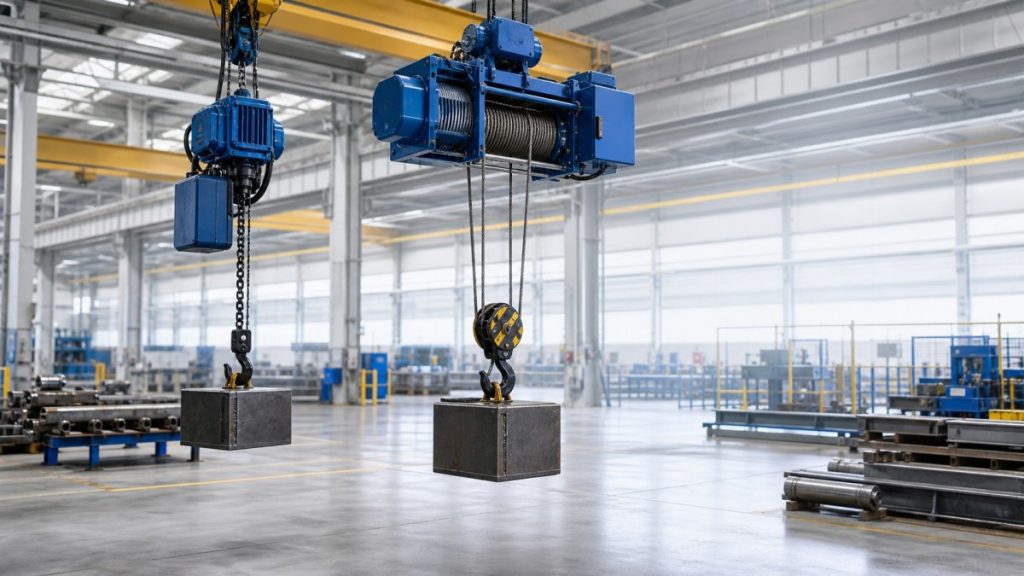
Choosing between an electric chain hoist and a wire rope hoist is not only a price decision. The correct choice depends on load capacity, lifting height, operating frequency, positioning accuracy, headroom, maintenance conditions and the type of crane system where the hoist will be installed.
For light and medium-duty lifting, an electric chain hoist can be compact, economical and easy to maintain. For higher capacities, longer lifting heights and continuous industrial service, a wire rope hoist is often the better engineering solution. This guide explains the differences in practical terms so that purchasing managers, plant engineers and project contractors can specify the right hoist before requesting a quotation.
If you are planning a new crane or hoist project, KRC provides both talhas elétricas de corrente e guinchos de cabo de aço for industrial lifting applications.
1. Basic Difference: Chain Lifting vs Rope Drum Lifting
An electric chain hoist uses a load chain running through a lifting mechanism. The chain is collected in a chain bag as the hook rises. This design is compact, relatively simple and well suited to workshops, warehouses, assembly stations and maintenance areas.
A wire rope hoist uses a steel wire rope wound around a drum. The rope passes through sheaves and a hook block to lift the load. This structure is better suited to heavier loads, longer lifting heights and high-frequency lifting operations.
In regulatory language, OSHA defines a hoist as equipment used for lifting or lowering, and its overhead crane standard includes requirements for hoist chains, hoist ropes, brakes, inspections and load handling. You can refer to OSHA 29 CFR 1910.179 for official requirements related to overhead and gantry cranes.
2. Quick Comparison Table
| Selection Factor | Electric Chain Hoist | Talha de cabo de aço |
|---|---|---|
| Typical capacity range | Best for light to medium loads | Better for medium to heavy loads |
| Lifting height | Good for short to moderate lift heights | Better for long lift heights |
| Espaço livre | Compact, especially with low-headroom models | Available in low-headroom designs, but generally larger |
| Duty cycle | Suitable for intermittent or moderate use | Better for frequent and continuous operation |
| Positioning | Good for assembly and workstation lifting | Stable for heavy and long-travel lifting |
| Manutenção | Chain inspection, lubrication and chain bag checks | Rope, drum, sheave and reeving inspection |
| Best applications | Workstations, maintenance, small cranes, light production | Overhead cranes, gantry cranes, heavy manufacturing, high-duty use |
3. When to Choose an Electric Chain Hoist
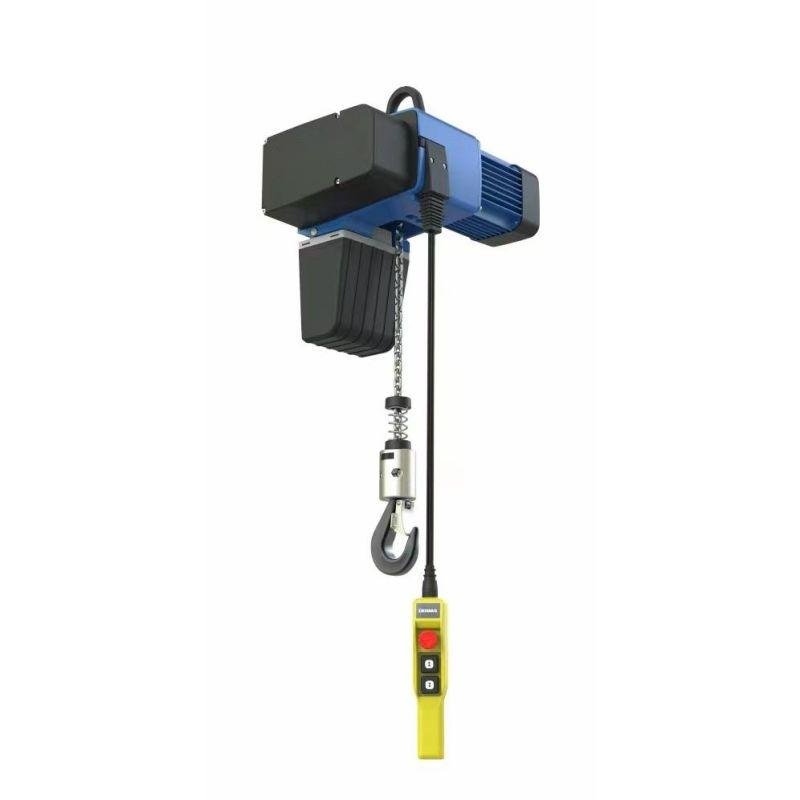
An electric chain hoist is usually the practical choice when the load is moderate, the lifting height is not excessive and the application requires a compact lifting unit. It is commonly used with jib cranes, KBK light crane systems, monorails, small overhead cranes and maintenance lifting points.
Choose an electric chain hoist when:
- The working load is within the chain hoist’s rated capacity range.
- The lifting height is short or moderate.
- The workshop has limited headroom.
- The lifting task is intermittent rather than continuous heavy production.
- The equipment needs to be compact and easy to install.
- The project requires a cost-effective lifting solution.
KRC electric chain hoists include standard industrial models, European-style models and intelligent hoist options. For applications requiring accurate positioning, KRC also provides guinchos inteligentes with servo control and stepless speed regulation.
4. When to Choose a Wire Rope Hoist
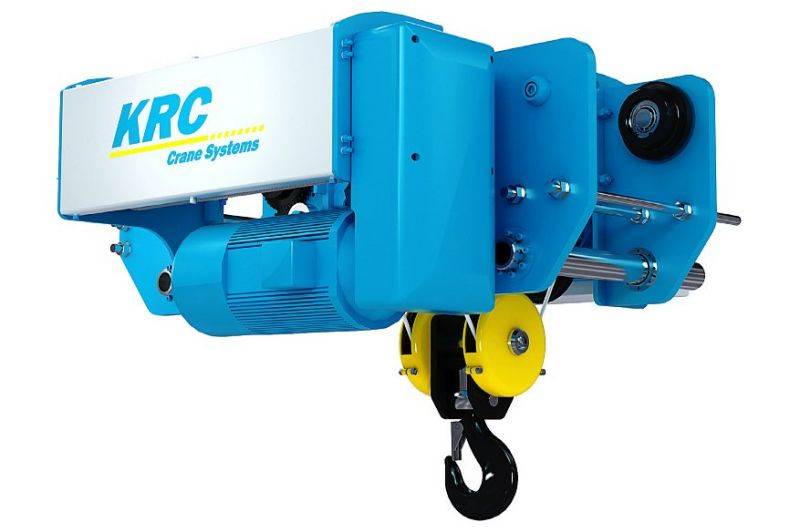
A wire rope hoist is often the stronger choice for heavy-duty production environments. Because the wire rope is wound on a drum and can be arranged through multiple falls, this type of hoist is well suited to larger loads, longer hook travel and stable lifting on overhead cranes or gantry cranes.
Choose a wire rope hoist when:
- The required capacity is high.
- The lift height is long.
- The hoist will operate frequently during each shift.
- The crane needs smooth lifting and travel control.
- The project involves steel fabrication, machinery production, automotive manufacturing, logistics or heavy assembly.
- The hoist must integrate with a single girder or double girder overhead crane.
KRC wire rope hoists include European low-headroom designs and standard CD/MD-type hoists. For complete crane systems, they can be integrated with KRC overhead cranes and gantry cranes.
5. Capacity and Lift Height: The First Engineering Filter
The first selection step is to define the maximum load, lifting height and hook path. Do not size the hoist only by the average load. The rated load must cover the maximum lifted load, including below-the-hook devices such as lifting beams, grabs, magnets, spreaders or custom fixtures.
As a practical rule, electric chain hoists are usually selected for lighter and medium loads, while wire rope hoists become more suitable as load capacity and lifting height increase. KRC’s electric chain hoist range includes models for compact lifting applications, while its wire rope hoist range is designed for industrial crane systems and higher-performance lifting requirements.
OSHA also states that cranes shall not be loaded beyond their rated load except for test purposes. For new and altered cranes, OSHA interpretation guidance refers to rated load test requirements and notes that test loads shall not exceed 125% of rated load unless otherwise recommended by the manufacturer. See OSHA’s official interpretation on rated load tests for new or altered cranes.
6. Duty Cycle: Why Operating Frequency Changes the Answer
Two hoists with the same rated capacity can perform very differently if one is used occasionally and the other is used hundreds of times per day. Duty cycle should be evaluated using expected operating time, number of starts, lifting distance, load spectrum and service environment.
International crane classification systems evaluate service conditions by working cycles and load spectrum. ISO 4301-1:2016 explains crane classification based on total working cycles, load spectrum factor and average displacements. The official ISO overview is available here: ISO 4301-1:2016 Cranes — Classification — Part 1.
For hoists specifically, ASME B30.16 covers construction, installation, operation, inspection, testing and maintenance requirements for overhead underhung and stationary hoists, including electric-powered chain and wire rope hoists. See the official ASME standard page: ASME B30.16 — Overhead Underhung and Stationary Hoists.
7. Headroom and Building Constraints
Headroom is the vertical distance required by the hoist and trolley structure between the runway beam and the hook. In existing workshops, headroom can directly determine whether the customer can lift the required load high enough for production.
Electric chain hoists are often compact and can be effective where space is limited. Low-headroom chain hoists can further improve hook approach and lifting height. Wire rope hoists can also be designed in low-headroom configurations, especially for European single girder cranes, but the structure is usually larger than a compact chain hoist.
If the building height is restricted, compare these values before choosing the hoist:
- Available clear height under the roof or runway beam.
- Required maximum hook height.
- Hoist headroom dimension.
- Hook approach at both ends of travel.
- Load height, rigging height and safety clearance.
For low buildings or workshops where every millimeter matters, KRC’s extra low-headroom electric chain hoist can be considered for compact lifting needs.
8. Maintenance and Inspection Differences
Both chain hoists and wire rope hoists require regular inspection. The difference is what must be checked most carefully.
For electric chain hoists, maintenance focuses on chain wear, chain lubrication, chain elongation, hook condition, brake performance, limit switches and the chain bag. For wire rope hoists, inspection must also focus on wire rope condition, drum winding, sheaves, rope reeving, broken wires, kinks, crushing and proper rope wraps on the drum.
OSHA requires attention to rope condition and safe load handling. For example, OSHA 1910.179 includes provisions related to wire rope defects, load balance, brake testing and the requirement that hoist rope or chain must not be kinked or twisted during load handling. These are not abstract rules; they directly affect daily operating safety.
9. Application Examples
Example A: Workstation Assembly
A factory needs to lift 250–500 kg components repeatedly at an assembly station. The lifting height is short, positioning accuracy is important and the operator works close to the load. A compact electric chain hoist or intelligent chain hoist is usually suitable. If ergonomic control and precise positioning are required, an intelligent hoist can improve handling efficiency.
Example B: Steel Fabrication Workshop
A steel fabrication plant needs to lift 10–20 ton steel structures across a wide production bay. The hoist operates frequently during each shift, and the crane must provide stable travel and long service life. In this case, a wire rope hoist integrated with an overhead crane is usually more appropriate.
Example C: Existing Workshop with Low Roof Height
A customer wants to add lifting equipment in an existing building where the roof height is limited. If the load is moderate, a low-headroom electric chain hoist may provide better usable lifting height. If the load is heavy, a low-headroom wire rope hoist on a European single girder crane may be required.
10. Selection Checklist Before Requesting a Quote
Before contacting a hoist supplier, prepare the following information. This allows engineers to recommend the correct hoist type instead of giving only a basic price.
- Rated load capacity.
- Maximum load weight including lifting accessories.
- Lifting height.
- Available headroom and building clear height.
- Power supply voltage, phase and frequency.
- Working frequency per hour and per shift.
- Required lifting speed and travel speed.
- Indoor or outdoor environment.
- Temperature, humidity, dust, corrosion or explosion-risk conditions.
- Control method: pendant, remote control, VFD or intelligent control.
- Installation method: fixed suspension, monorail trolley, jib crane, KBK system, overhead crane or gantry crane.
Conclusion: Match the Hoist to the Real Working Condition
An electric chain hoist is not automatically “smaller” or “lower quality,” and a wire rope hoist is not automatically the best solution for every project. The correct choice depends on the actual lifting task.
Use an electric chain hoist when the application needs compact size, moderate capacity, simple maintenance and cost-effective lifting. Use a wire rope hoist when the project requires higher capacity, longer lifting height, heavier duty cycle and integration with industrial crane systems.
If you are unsure which hoist type fits your project, send KRC your load capacity, lifting height, building dimensions and working frequency. Our engineering team can recommend a suitable electric chain hoist, wire rope hoist or complete crane system based on your working conditions.
Contact KRC Cranes to request a customized hoist selection proposal.
Perguntas frequentes
Is a wire rope hoist stronger than an electric chain hoist?
In general, wire rope hoists are preferred for higher capacities and longer lifting heights. Electric chain hoists are highly effective for light and medium-duty lifting, especially where compact size and simple installation are important.
Which hoist is better for low-headroom workshops?
For moderate loads, a low-headroom electric chain hoist can be a practical choice. For heavier loads, a European low-headroom wire rope hoist may be required. The final decision depends on load capacity, beam structure and required hook height.
Which hoist requires less maintenance?
Electric chain hoists are usually simpler to inspect and maintain. Wire rope hoists require more detailed inspection of rope condition, drum winding and sheaves, but they are better suited to heavy-duty applications.
Can both hoist types be used with overhead cranes?
Yes. Electric chain hoists can be used with smaller overhead cranes, monorails, jib cranes and KBK systems. Wire rope hoists are widely used with single girder cranes, double girder cranes and gantry cranes.
 English
  Русский
  Português
  Deutsch
  Français