
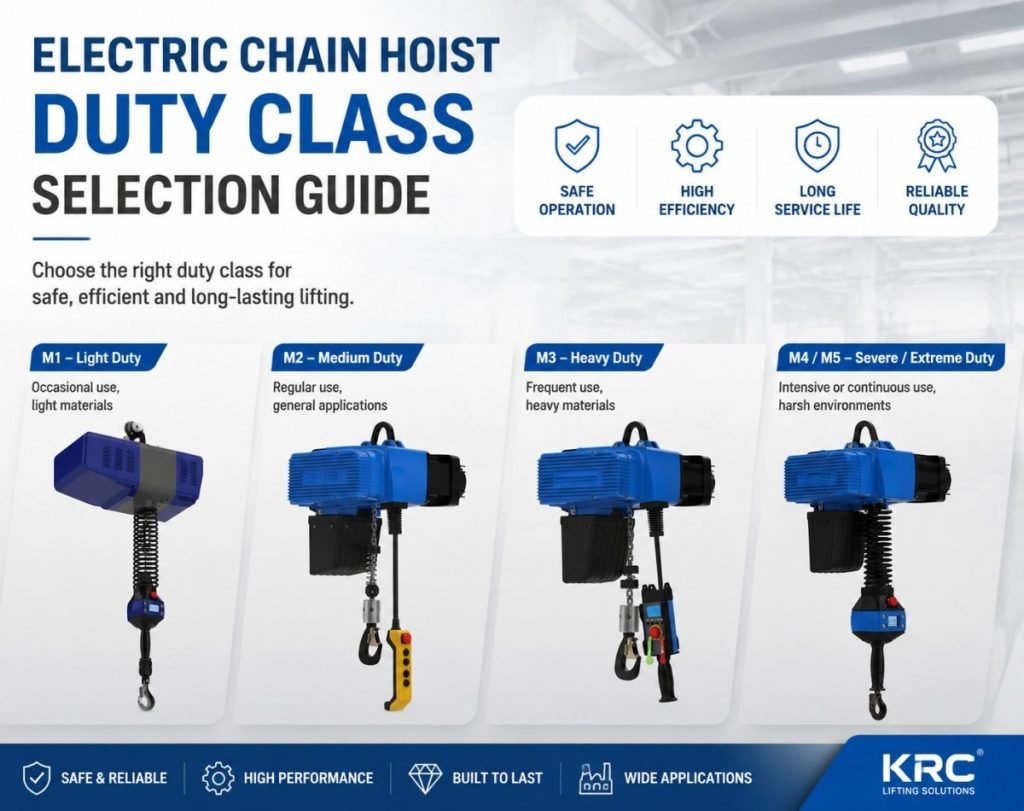
When selecting an electric chain hoist, many buyers first compare lifting capacity, lifting speed, headroom and overall dimensions. These specifications are important, but they are not enough. A hoist that has the correct rated capacity can still be unsuitable if the motor duty, number of starts, lifting height and operating frequency are not matched to the actual working condition.
This is why hoist duty class matters. The duty class describes how hard and how often the hoist is expected to work. It helps engineers evaluate whether the motor, brake, gearbox, chain, electrical system and thermal performance are suitable for the application.
For projects involving workstation cranes, jib cranes, KBK systems, assembly lines and maintenance lifting points, understanding duty class helps prevent overheating, premature wear and unnecessary downtime. KRC provides talhas elétricas de corrente, guinchos inteligentes and complete Sistemas de guindastes leves KBK for industrial lifting applications.
1. Why Duty Class Is More Than Rated Load
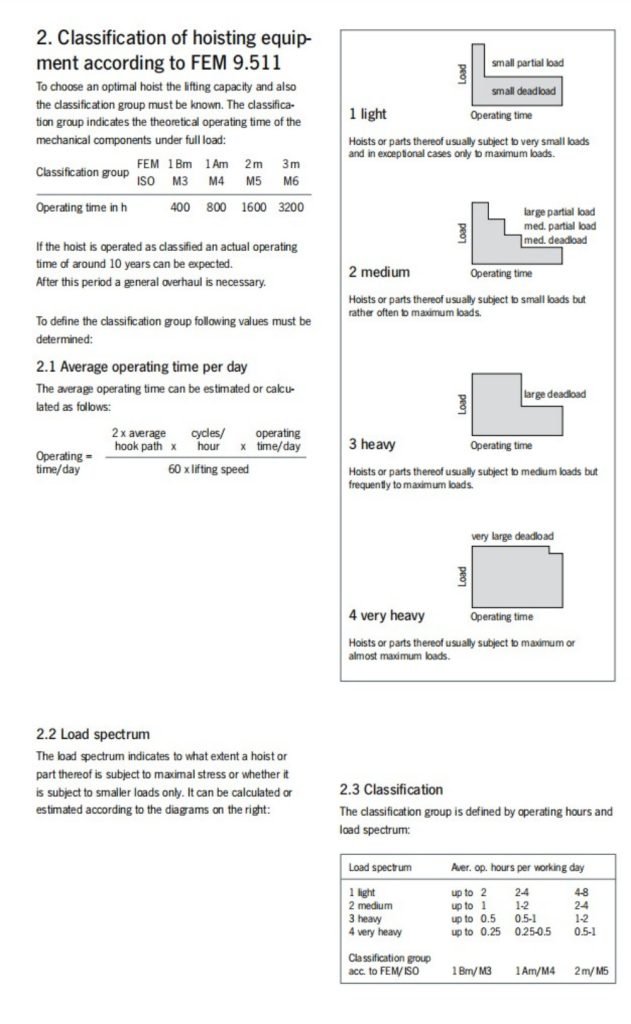
Rated load tells you the maximum load the hoist can lift under defined conditions. Duty class tells you whether the hoist can perform the required number of lifting operations over time without exceeding the allowable motor temperature and mechanical service limits.
For example, two factories may both need a 1 ton electric chain hoist. The first factory uses the hoist only a few times per day for maintenance. The second factory uses the same capacity hoist repeatedly on an assembly line. Although the rated load is identical, the second application requires a higher working level because the number of starts and operating time are much higher.
International crane classification methods consider service conditions such as working cycles and load spectrum. ISO 4301-1:2016 describes crane classification based on total working cycles, load spectrum factor and related operating conditions. The official ISO overview is available here: ISO 4301-1:2016 Cranes – Classification – Part 1.
2. Motor Selection According to FEM 9.683
For electric chain hoists, motor selection is not determined only by torque. Heat generation is a decisive factor. During lifting and lowering, the motor produces heat. If the hoist starts too often or operates for too long without sufficient cooling time, the motor temperature may exceed the permitted limit.
FEM 9.683 is commonly used in the hoist industry to evaluate electric hoist motor duty. In practical selection, it separates operating conditions into two basic modes:
- Intermittent duty: repeated operating cycles with load periods and rest periods.
- Short time duty: continuous operation for a limited period under defined conditions, followed by enough cooling time.
The key point is simple: the motor must be selected for the real operating pattern, not only for the maximum load.
3. Intermittent Duty: Cycles, Starts and Cooling Time
Intermittent duty describes a series of similar working cycles. Each cycle includes a lifting period, a lowering period and rest periods. The motor temperature depends on how long the motor runs compared with the total cycle time, and how many times the motor starts per hour.
The main selection parameters are:
- S: cycles per hour
- ED: duty rating, expressed as a percentage
- V: lifting speed, in meters per minute
- E: average lifting height, in meters
In hoist selection practice, a cycle usually includes lifting, lowering and rest time. The number of starts must also be checked, because frequent starting can generate more heat than steady running. A common engineering assumption is that one complete cycle may involve multiple motor starts, so the start frequency must not exceed the hoist motor’s permitted value.
Practical note: If the lifting height increases while the lifting speed remains the same, the motor running time per cycle increases. This reduces the number of allowable full-load cycles per hour.
4. Short Time Duty: Long Hook Path or Special Operating Conditions
Short time duty applies when the hoist operates under a constant load for a defined period, but not long enough for the motor to reach thermal stability. After this period, the hoist must stop for sufficient time so the motor can cool down before the next operation.
This mode is especially relevant when the application has a long hook path, a high lifting height or special operating conditions. Instead of evaluating many repeated short cycles, engineers check whether the hoist can operate for the required continuous period without exceeding the allowed motor temperature.
For example, a hoist used to raise equipment through several floors may need to lift for a long continuous duration. Even if the operation happens only a few times per day, the motor must be suitable for that short-time running requirement.
5. How to Estimate the Required Working Level
Before requesting a quote, prepare realistic operating data. Guessing too low may lead to overheating and reduced service life. Guessing too high may increase cost unnecessarily.
| Parâmetro | Why It Matters | Example Input |
|---|---|---|
| Rated load | Defines the required hoist capacity and safety margin | 1 ton, 2 ton, 5 ton |
| Average lifting height | Determines motor running time per cycle | 3 m, 6 m, 12 m |
| Velocidade de elevação | Affects cycle time and productivity | 4 m/min, 8 m/min |
| Cycles per hour | Shows how often the hoist repeats work | 10, 30, 60 cycles/hour |
| Starts per hour | Directly affects motor heating | 60, 120, 150 starts/hour |
| Load spectrum | Shows whether the hoist usually lifts light loads or near-rated loads | Mostly 30%, often 80-100% |
KRC has developed an online calculator to help estimate the required working class. You can enter basic values and use the result as a starting point for engineering discussion: KRC duty class calculator.
6. Worked Example: Why Average Lifting Height Changes the Result
Assume a customer needs an electric chain hoist for a workstation application:
- Rated load: 1 ton
- Average lifting height: 4 m
- Lifting speed: 8 m/min
- Operating frequency: 20 cycles/hour
- Typical load: 60-80% of rated load
At 8 m/min, lifting 4 m takes about 0.5 minutes. Lowering may take a similar time depending on the selected speed. If this repeats 20 times per hour, the motor operating time and number of starts must be checked against the permitted duty rating.
Now compare this with the same hoist lifting 10 m instead of 4 m. Each cycle requires much longer motor running time. Even if the load capacity is unchanged, the hoist may need a higher duty class or a different motor configuration.
This is the most common selection mistake: customers specify the rated load correctly but underestimate the effect of lifting height and cycle frequency.
7. Duty Class and Safety Standards
Duty class selection is an engineering decision, but safe use also depends on installation, inspection, testing and operation. ASME B30.16 covers overhead underhung and stationary hoists, including electric-powered chain hoists and wire rope hoists. It addresses construction, installation, inspection, testing, operation and maintenance requirements. See the official ASME page: ASME B30.16 Overhead Underhung and Stationary Hoists.
For overhead and gantry crane applications, OSHA 29 CFR 1910.179 includes requirements related to rated loads, hoist ropes and chains, inspection and safe load handling. The official regulation is available here: OSHA 1910.179 Overhead and Gantry Cranes.
These standards do not replace project-specific engineering review. They provide a safety framework, while the final hoist selection should be based on the real operating condition and the manufacturer’s technical data.
8. Common Selection Mistakes
- Only checking rated load: Capacity is necessary, but it does not define duty class by itself.
- Ignoring average lifting height: Longer lifting height increases motor running time per cycle.
- Underestimating starts per hour: Frequent starting can generate significant motor heat.
- Using peak demand as normal demand: Occasional heavy lifts and continuous heavy-duty production should be evaluated differently.
- Not considering cooling time: Rest periods are part of thermal selection.
- Ignoring environment: High temperature, dust, humidity or corrosive conditions may require special protection.
9. Information to Send Before Buying an Electric Chain Hoist
To receive an accurate recommendation, provide the following information to the hoist supplier:
- Rated load and maximum lifted load including below-the-hook devices.
- Average and maximum lifting height.
- Required lifting speed and travel speed.
- Cycles per hour and working hours per day.
- Expected starts per hour.
- Typical load spectrum: light, medium, heavy or near-rated-load use.
- Power supply voltage, phase and frequency.
- Installation method: fixed suspension, manual trolley, electric trolley, jib crane, KBK rail or overhead crane.
- Indoor/outdoor environment and any dust, humidity, corrosion or explosion-risk factors.
- Control preference: pendant, wireless remote, inverter control or intelligent control.
10. Conclusion: Select the Hoist by Real Work, Not Only by Nameplate Capacity
The correct electric chain hoist working level depends on how the hoist will actually be used. Rated load, lifting speed and dimensions are only the starting point. Motor heat, intermittent duty, short time duty, average lifting height, cycles per hour and starts per hour determine whether the hoist can perform reliably in daily production.
If your application has frequent lifting, long hook travel or near-rated-load operation, do not select the hoist only from a catalog table. Send the operating data to KRC so our engineering team can recommend a suitable electric chain hoist, intelligent hoist or complete crane system.
Contact KRC Cranes to request an electric chain hoist selection proposal.
Perguntas frequentes
What is electric chain hoist duty class?
Electric chain hoist duty class describes how often and how heavily the hoist can work under defined conditions. It considers operating time, cycles, starts, lifting height and load spectrum, not only rated capacity.
Why does average lifting height affect duty class?
Higher lifting height increases motor running time per cycle. If the hoist repeats this operation many times per hour, the motor may generate more heat and require a higher duty rating.
What is intermittent duty for a hoist?
Intermittent duty means the hoist works in repeated cycles, with running periods under load and rest periods. The motor must have enough cooling time between operating periods.
When should short time duty be considered?
Short time duty should be considered when the hoist needs to operate continuously for a defined period, such as long hook travel or special lifting operations, followed by sufficient cooling time.
Can KRC help calculate the required hoist working class?
Yes. KRC can evaluate your load, lifting height, cycles per hour, starts per hour and working environment. You can also use the KRC duty class calculator as an initial reference.
 English
  Русский
  Português
  Deutsch
  Français