
Choisir un pont roulant ne se résume pas à sélectionner une capacité de levage dans un catalogue. Deux ponts roulants conçus pour la même charge maximale peuvent présenter des structures, des palans, des moteurs, des freins et des durées de vie prévues très différentes.
Les spécifications d'un pont roulant doivent tenir compte du spectre de charge réel, du nombre de cycles de fonctionnement, de la portée, de la hauteur de levage, de la course, de l'environnement et de la précision de positionnement requise. Ce guide explique l'interaction de ces facteurs et les informations nécessaires au fabricant du pont roulant pour proposer une solution sûre et économique.
1. Déterminer la capacité de levage requise
La capacité nominale de la grue doit couvrir la charge totale suspendue, et non seulement le poids nominal de la pièce. Incluez tout élément transporté sous le crochet :
- La pièce ou le composant de machine le plus lourd
- Élingues, manilles et chaînes de levage
- palonniers, pinces, aimants ou autres dispositifs sous crochet
- Tous les éléments de fixation qui restent attachés pendant le levage
Par exemple, une pièce de 9 200 kg soulevée avec une poutre d'écartement de 500 kg et un système d'élingues de 300 kg génère une charge suspendue totale de 10 000 kg. Le dimensionnement de la grue se baserait uniquement sur le poids de la pièce à manipuler et sous-estimerait la charge réelle.
Important: N’ajoutez pas de pourcentage arbitraire pour compenser l’incertitude des données de charge. Déterminez la charge maximale réelle suspendue et laissez un ingénieur spécialisé en grues définir la marge de conception appropriée.
L’Administration américaine de la sécurité et de la santé au travail (OSHA) définit la charge nominale comme la charge maximale pour laquelle la grue ou le palan est conçu et construit, telle qu’indiquée sur sa plaque signalétique. L’OSHA précise également qu’une grue ne doit pas être chargée au-delà de sa charge nominale, sauf lors d’un essai autorisé. Voir OSHA 29 CFR 1910.179.
Si la charge est occasionnellement beaucoup plus lourde que la normale, veuillez indiquer les deux valeurs dans votre demande de devis. La charge maximale détermine la capacité, tandis que la répartition des levages légers, moyens et lourds permet de déterminer la catégorie de service.
2. Mesurer la portée et la géométrie du bâtiment
La portée du pont roulant correspond généralement à la distance horizontale entre les axes des rails de roulement. Il ne s'agit pas simplement de la largeur libre de l'atelier.
Les dimensions suivantes doivent être mesurées ou confirmées à partir des plans de structure :
- distance entre les axes des rails de la piste
- Longueur totale de la piste
- Distance entre le sol et le haut du rail
- Distance entre le haut du rail et l'obstacle le plus bas du toit
- Approche en crochet requise des deux côtés
- Colonnes, conduits, éclairage, tuyaux et autres obstructions
- Accès disponible pour l'installation et la maintenance
L'allongement des portées accroît les contraintes de flexion, le poids propre des poutres et la charge sur les roues. Un pont plus long peut donc nécessiter une poutre unique plus profonde ou une structure à double poutre, même si la capacité de levage reste inchangée.
L'adéquation du bâtiment doit également être vérifiée. Les poutres, colonnes et fondations existantes peuvent nécessiter une inspection par un ingénieur structure qualifié. Augmenter la capacité de la grue sans vérifier la structure porteuse n'est pas une stratégie de modernisation acceptable.
À titre d'exemple spécifique à certaines juridictions, l'OSHA mentionne des dégagements minimaux de 7,6 cm (3 pouces) au-dessus et de 5 cm (2 pouces) latéralement entre une grue et les obstacles. Les réglementations locales et les normes de conception du projet doivent toujours prévaloir.
3. Calculer la hauteur de levage et la hauteur libre.
La hauteur de levage correspond à la distance verticale que le crochet doit parcourir entre ses positions de travail la plus basse et la plus haute. La hauteur libre est l'espace occupé par la grue et le palan au-dessus de la position la plus haute du crochet.
Avant de choisir un palan, définissez :
- Position de crochet minimale requise
- Position de crochet la plus élevée requise
- Hauteur du sol à la piste
- Restrictions relatives au toit et à la hauteur libre pour les services
- Profondeur des fosses, des machines ou des cuves de traitement
Un palan à câble à faible hauteur sous plafond ou une grue européenne optimisée peuvent permettre d'augmenter la hauteur de levage dans un bâtiment existant. Dans certains cas, récupérer même un modeste espace vertical permet d'éviter les coûts bien plus élevés liés à la surélévation du toit ou à la modification de la structure porteuse.
4. Sélectionnez la classe de service de grue appropriée
La capacité indique la charge maximale admissible. La classe de service décrit l'intensité de fonctionnement prévue de la grue et de ses mécanismes.
ISO 4301-1:2016 La classification des grues et des mécanismes repose principalement sur le nombre total de cycles de fonctionnement pendant leur durée de vie nominale et sur le spectre de charge. C'est pourquoi deux grues de 10 tonnes peuvent nécessiter des moteurs, des réducteurs, des freins, des câbles et des structures différents.
Informations nécessaires à la classification des fonctions
- Ascenseurs par heure
- Heures de travail par quart de travail
- Nombre de quarts de travail par jour
- jours d'exploitation par an
- Durée de vie prévue
- Pourcentage de levages à différents niveaux de charge
- Distance de levage moyenne
- Vitesses de levage et de déplacement requises
Estimation de cycle simple
Une estimation préliminaire du cycle de vie peut être calculée comme suit :
Nombre de levages par heure × heures de fonctionnement par jour × jours de fonctionnement par an × durée de vie nominale
Pour une grue effectuant 8 levages par heure, fonctionnant 8 heures par jour, 250 jours par an pendant 15 ans :
8 × 8 × 250 × 15 = 240 000 cycles de levage
Il ne s'agit que d'une estimation initiale. L'ingénieur doit encore prendre en compte le poids des charges, la distance qu'elles parcourent et le fonctionnement de chaque mécanisme au cours d'un cycle de travail complet.
Classes de service typiques de la CMAA
| Classe | Niveau de service général | Application typique |
|---|---|---|
| UN | En veille ou peu fréquent | Centrales électriques, installation d'équipements et longues périodes d'inactivité |
| B | Service léger | Ateliers de réparation et entreposage léger |
| C | Service modéré | Ateliers d'usinage, assemblage et fabrication générale |
| D | Service intensif | Fabrication lourde, fonderies, stockage et manutention de l'acier |
| E | Service sévère | Parcs à ferraille, cimenteries et opérations de traitement à haute fréquence |
| F | service sévère continu | Grues spécialisées fonctionnant en continu à proximité de leur capacité nominale |
Les catégories ci-dessus constituent un aperçu pratique et ne sauraient se substituer à un calcul d'ingénierie. Les exigences détaillées sont décrites dans [référence manquante]. Spécification CMAA n° 70Une explication utile concernant le secteur est également disponible dans le livre de Demag. Aperçu de la classification des grues et des palans.
5. Choisissez la configuration de la grue
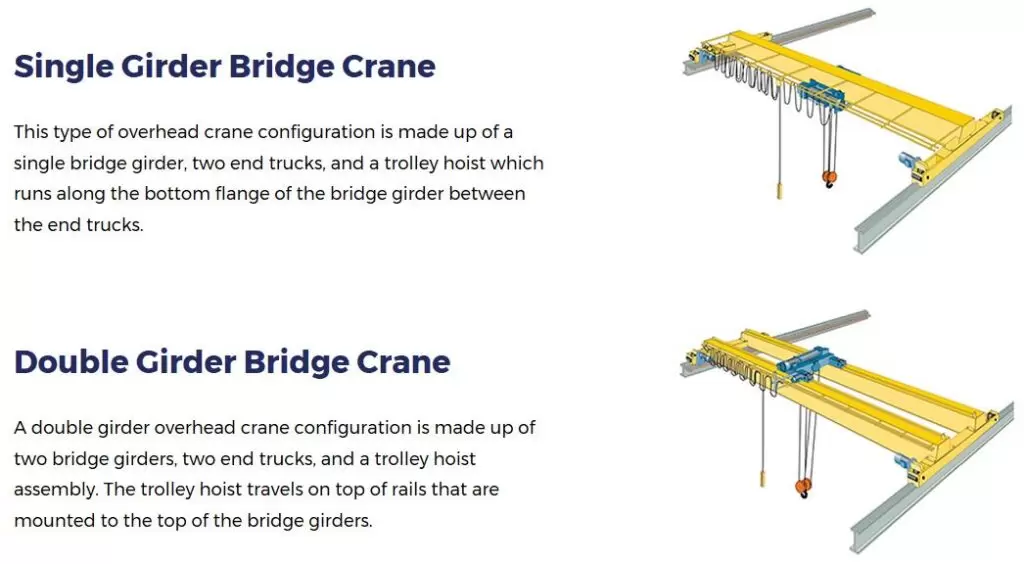
Pont roulant monopoutre
Une grue monopoutre convient souvent aux charges légères à moyennes, aux portées modérées et aux applications où la réduction du poids propre et du coût du projet est primordiale. Le palan se déplace généralement sous la poutre du pont.
Pont roulant à double poutre
On privilégie généralement une grue bipoutre lorsque le projet requiert une capacité élevée, une grande portée, des conditions de travail exigeantes, une hauteur de levage importante ou des accessoires de levage spécifiques. Un chariot à déplacement supérieur permet d'améliorer la hauteur du crochet et facilite l'accès aux plateformes de service.
Pour une comparaison détaillée, consultez le rapport de KRC. Guide comparatif des ponts roulants monopoutre et bipoutre.
Grue suspendue
Une grue suspendue ou à roulement se déplace sous la structure de la voie de roulement. Elle peut s'avérer utile lorsque la configuration du bâtiment permet l'installation de voies suspendues ou lorsque les colonnes de plancher gêneraient la production.
Grue à portique ou semi-portique
Une grue à portique supporte sa passerelle sur des pieds plutôt que de reposer entièrement sur une voie de roulement surélevée. Elle est fréquemment choisie pour les chantiers extérieurs, les zones de construction et les bâtiments qui ne peuvent supporter les charges d'une voie de roulement classique.
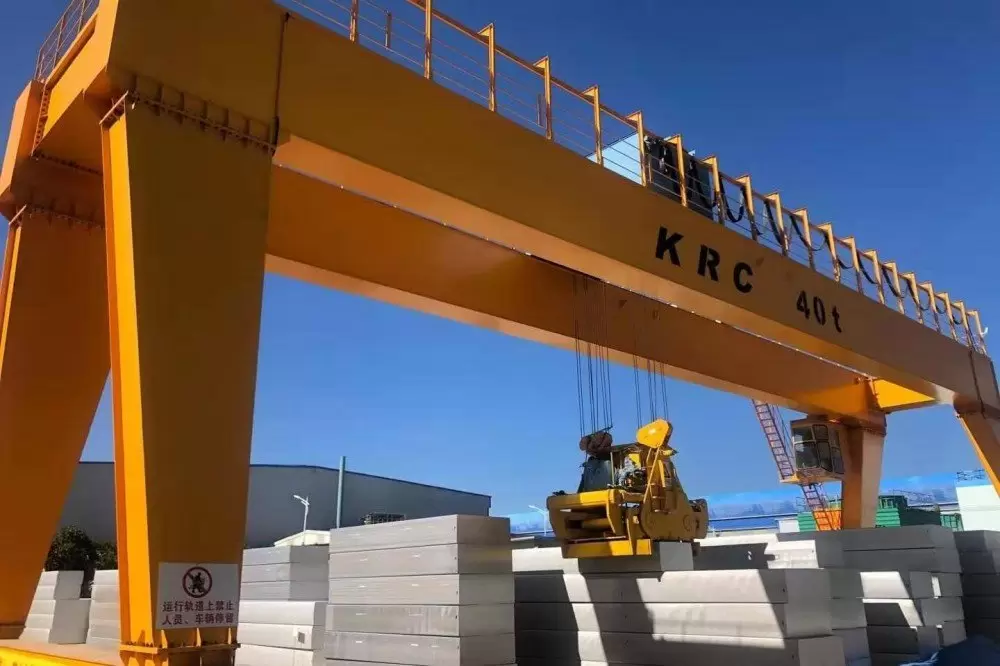
Voir KRC Solutions européennes pour portiques et semi-portiques.
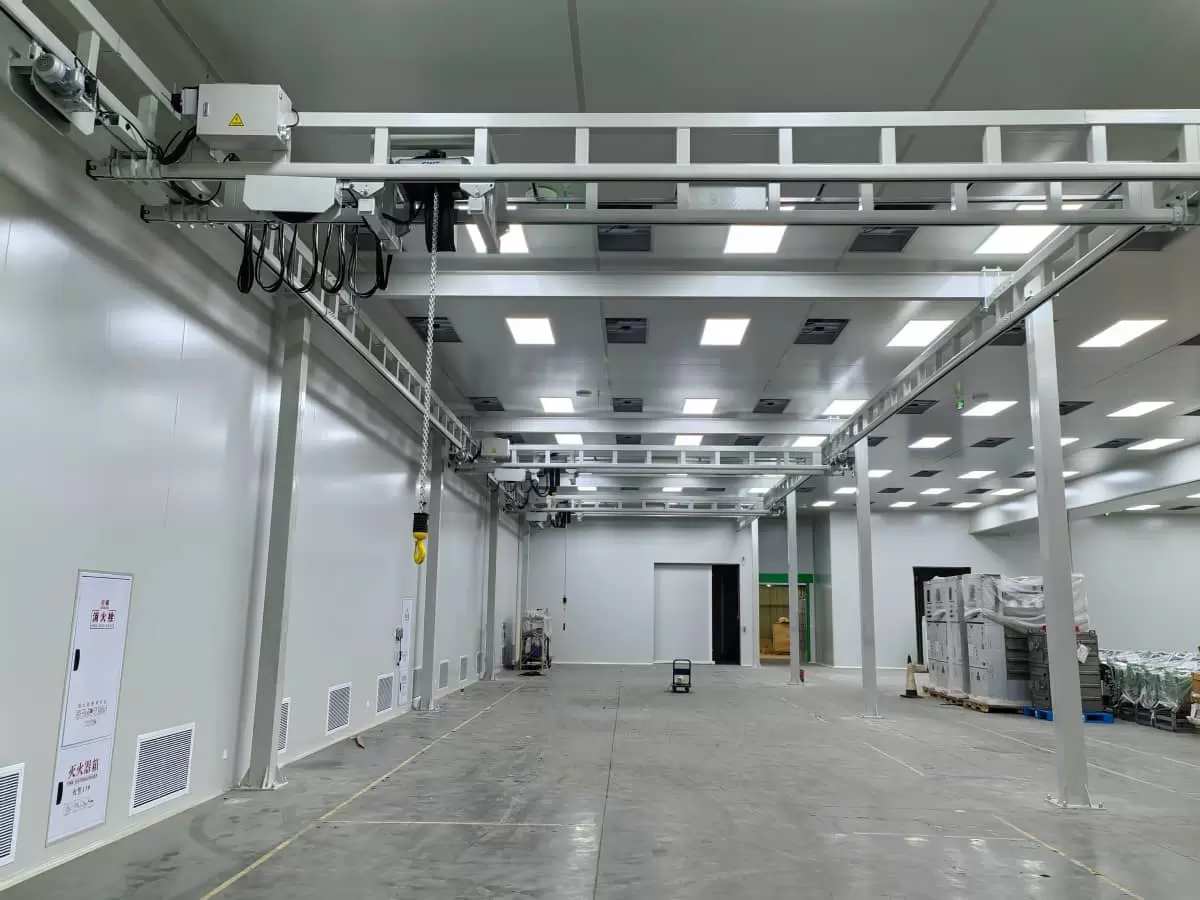
Système de grue légère KBK
Pour la manutention répétitive de postes de travail et les charges légères, un système de pont roulant modulaire peut s'avérer plus efficace qu'un pont roulant conventionnel. (KRC) Systèmes de grues légères KBK sont destinées aux chaînes de montage, aux cellules de production et à la logistique des postes de travail.
6. Définir l'environnement d'exploitation
Les conditions environnementales peuvent modifier les moteurs, les boîtiers électriques, les freins, les revêtements, les câbles et les commandes requis. Veuillez inclure les informations suivantes dans le cahier des charges :
- fonctionnement intérieur ou extérieur
- température ambiante minimale et maximale
- Exposition à l'humidité, à la pluie, à la neige, au vent et au soleil
- Poussières, vapeurs, brouillards d'huile ou produits chimiques corrosifs
- Zones de gaz dangereux ou de poussières combustibles
- Matériaux à haute température ou métal en fusion
- exigences en matière de salles blanches, de transformation des aliments ou d'hygiène
- Altitude et alimentation électrique disponible
Les équipements antidéflagrants doivent être choisis en fonction de la classification de la zone dangereuse, du groupe de gaz ou de poussières et de la classe de température. L’appellation « antidéflagrant » ne doit jamais être considérée comme une option générique.
Pour les applications dangereuses, voir les documents de KRC. Comparaison des certifications ATEX, IECEx et GB.
7. Exemple de sélection d'un pont roulant.
Envisagez un atelier de fabrication répondant aux exigences préliminaires suivantes :
- Poids maximal de la pièce : 8,5 tonnes
- Poutre de levage et d'arrimage : 1,0 tonne
- Charge suspendue maximale totale : 9,5 tonnes
- Envergure de la piste : 18 mètres
- Hauteur de levage requise : 8 mètres
- 6 à 10 ascenseurs par heure
- Un poste de 8 heures, 250 jours par an
- La plupart des chargements se situent entre 3 et 6 tonnes.
- Des levages occasionnels proches de la capacité maximale
- Environnement intérieur non dangereux
Une grue de 10 tonnes peut sembler convenir du seul point de vue de sa capacité. Cependant, le choix final doit également prendre en compte le nombre de cycles de fonctionnement, le spectre de charge, les vitesses requises, la capacité de la voie de roulement du bâtiment et la hauteur libre disponible.
Selon ces calculs, le projet d'ingénierie pourrait prévoir un pont roulant monopoutre pour une solution économique adaptée aux charges modérées, ou un pont roulant bipoutre si la hauteur sous crochet, l'accessibilité pour la maintenance ou les exigences futures du processus le justifient. La solution optimale dépend du profil d'exploitation complet, et non de la seule capacité.
8. Liste de contrôle pour la demande de devis de pont roulant
Fournir des informations complètes dès la phase de devis réduit le travail de reconception et permet d'obtenir une proposition plus précise.
- Charge totale maximale suspendue
- Charge et répartition de charge typiques
- Portée et longueur de piste
- Hauteur de levage requise
- Dimensions du sol au rail et du rail au toit
- Nombre de levages par heure et de quarts de travail par jour
- Vie de conception souhaitée
- Vitesses de levage, de chariot et de pont
- conditions intérieures ou extérieures
- Détails relatifs à la température, à la poussière, à la corrosion et aux zones dangereuses
- Alimentation électrique
- Commande par pendentif, télécommande radio, commande en cabine ou automatisée
- Accessoires et dispositifs sous crochet requis
- normes nationales ou de projet applicables
- Plans de bâtiments et de pistes
Considérations relatives à la sécurité et à la conformité
Les exigences relatives aux grues varient selon la juridiction et l'application. Aux États-Unis, ASME B30.2 couvre la construction, l'installation, l'exploitation, l'inspection et la maintenance de ponts roulants et de portiques spécifiques.
L'OSHA exige que les charges nominales soient clairement indiquées et précise que les charges d'essai ne doivent pas dépasser 125% de la charge nominale, sauf recommandation contraire du fabricant. Ces dispositions ne doivent pas être interprétées comme une autorisation de fonctionnement régulier au-delà de la capacité nominale.
La conception finale, l'installation, les essais et la mise en service doivent être effectués conformément à la réglementation locale applicable, aux spécifications du projet et aux instructions du fabricant.
Conclusion
Le choix efficace d'un pont roulant nécessite cinq décisions interdépendantes :
- Déterminer la charge maximale réelle suspendue.
- Mesurer la portée, la hauteur de levage et les dégagements du bâtiment.
- Calculer le spectre de charge et les cycles de fonctionnement prévus.
- Choisissez une configuration de grue et de palan adaptée à la tâche.
- Spécifiez les exigences environnementales, de contrôle et de conformité.
Une grue surdimensionnée sans raison valable augmente les coûts de structure et de projet. Une grue sous-dimensionnée peut subir une usure excessive, des temps d'arrêt et des risques pour la sécurité. La solution la plus économique est celle qui correspond parfaitement au profil d'exploitation réel.
Demander un devis de grue technique
Veuillez transmettre à KRC vos spécifications de charge maximale, portée, hauteur de levage, fréquence de fonctionnement et vos plans d'atelier. Notre équipe d'ingénieurs vous aidera à déterminer la configuration de grue, le type de palan et la classe de service les mieux adaptés à votre application.
Demander une évaluation de sélection de grue
Explorez l'intégralité Gamme de grues KRC.
Foire aux questions
Quelle capacité de grue dois-je choisir ?
La capacité doit couvrir le poids de la pièce la plus lourde, ainsi que celui de tous les systèmes de levage, poutres et accessoires. Ne basez pas votre décision uniquement sur le poids de la pièce.
Une grue de plus grande capacité possède-t-elle automatiquement une classe de service supérieure ?
Non. La capacité et la classe de service décrivent des exigences différentes. La capacité concerne la charge maximale, tandis que la classe de service prend en compte les cycles de fonctionnement, le spectre de charge et la fréquence d'utilisation.
Quand dois-je choisir une grue à double poutre ?
Les ponts roulants bipoutres sont généralement choisis pour leurs capacités de levage élevées, leurs portées importantes, leur robustesse, la hauteur de levage accrue qu'ils offrent, leur accessibilité pour la maintenance ou leurs accessoires spécifiques. Le choix final nécessite une étude d'ingénierie adaptée au projet.
Quelles informations sont nécessaires pour obtenir un devis de pont roulant ?
Fournir les charges maximales et typiques, la portée, la hauteur de levage, la longueur de la piste, la fréquence de fonctionnement, l'environnement, les vitesses, les commandes, l'alimentation électrique et les plans du bâtiment disponibles.
Est-il possible de moderniser une grue existante pour augmenter sa capacité ?
Ce n'est qu'après évaluation de la grue, de la voie de roulement, de la structure porteuse et des mécanismes concernés par le fabricant ou un ingénieur qualifié que la grue modifiée doit être testée et correctement marquée conformément aux exigences applicables.
 English
  Русский
  Português
  Deutsch
  Français